Apply for probate in the UK: step-by-step process, forms and costs
When someone dies, their executor or next of kin must apply for probate to legally manage their estate. This document, called a Grant of Probate or Letters of Administration, gives you authority to access bank accounts, sell property, and distribute inheritance. Without it, financial institutions won’t release funds. The process involves completing form PA1P (with a will) or PA1A (without), submitting inheritance tax details to HMRC, and paying a £300 fee. Most applications take 8–12 weeks. You can apply for probate yourself online or use a solicitor.

Quick Answer: What does “apply for probate” mean?
- You’re requesting legal permission from HM Courts and Tribunals Service (HMCTS) to administer a deceased person’s estate; collecting assets, paying debts, and distributing inheritance to beneficiaries.
- You receive a Grant of Probate or Letters of Administration, a legal document proving you have authority. Financial institutions require this before releasing funds or transferring ownership.
- In many estates, financial institutions will not release assets until a Grant is issued, meaning distribution often cannot proceed until probate is granted. This protects beneficiaries and ensures debts are settled properly.
Consider a probate solicitor if the estate exceeds £500,000, inheritance tax is due, there’s no will, beneficiaries dispute distribution, or you’re unsure of your responsibilities.
Do you need probate? Quick decision guide
Probate is usually required if property or significant assets were held solely in the deceased’s name; the application fee is £300 (if the estate exceeds £5,000), and most Grants are issued within 8–14 weeks.
You’ll likely need to apply for probate if the estate includes:
- Assets held solely in the deceased’s name where the provider requires a Grant.
- Shares, investments, or certain insurance or pension benefits payable to the estate.
- Bank or building society accounts (providers set their own release thresholds; confirm directly with them).
- Property held as joint tenants passes automatically to the surviving owner. Property owned as tenants in common usually requires probate.
You probably won’t need probate if:
- Assets are held in trust or on behalf of beneficiaries.
- Only a will exists but no financial assets require probate.
- Everything was jointly owned (passes automatically to the survivor).
- Some institutions may release small balances without probate, but there is no universal threshold.
Who can apply for probate?
With a will: The executor named in the will (or a beneficiary if no executor is willing or able to act).
Without a will: The next of kin in the order prescribed by the Administration of Estates Act 1925, Section 46: spouse or civil partner, then children, then parents, then siblings.
You don’t need to be a solicitor; anyone can apply for probate themselves. However, you must be over 18 and able to understand your responsibilities as executor or administrator.
If multiple executors exist: One executor may apply initially. Others may reserve their power to act later or renounce their role entirely. If you’re applying alone, ensure you have the consent of co-executors, or they must formally renounce in writing.
Applying for probate with a will vs without a will: what’s different?
With a will (PA1P), the executor applies and distribution follows the will’s instructions. Without a will (PA1A), the next of kin applies and distribution follows intestacy rules in England and Wales, which gives the spouse a fixed share and children the remainder.
PA1P – With Will
- Download: UK: Form PA1P
- Complete with: deceased’s full details, executor declaration, gross and net estate value, all assets and debts, gifts made in 7 years before death (for tax purposes), your statement of truth confirming accuracy.
PA1A – Without Will
- Download: UK: Form PA1A
- Complete with: proof of your entitlement as next of kin (marriage/birth certificate), full estate details, declaration of all liabilities, confirmation you’ll distribute per intestacy law, your statement of truth.
Applying for probate: step-by-step
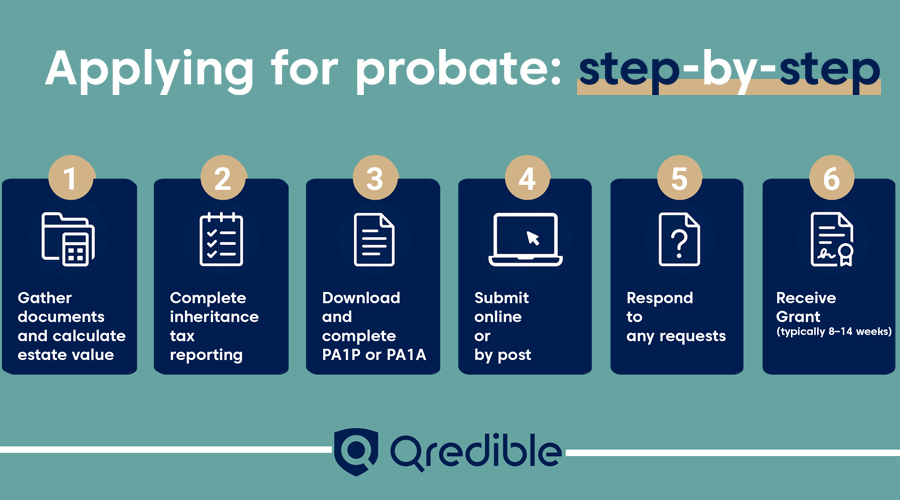
The process:
- Gather documents and create estate inventory. Locate the original will, order 4–6 certified death certificates, and contact all banks, investment providers, and insurers for statements dated to death. List all assets (property, savings, investments, vehicles, valuables) and debts (mortgages, loans, credit cards, bills). Obtain professional valuations for property if needed.
- Calculate estate value and determine tax obligations. Total all assets, subtract all debts. £325,000 is the current nil-rate band. Whether inheritance tax is payable depends on exemptions and available allowances (for example, spouse exemption or transferable allowances).
- Complete inheritance tax reporting and obtain HMRC reference. If the estate is not an excepted estate, you must submit a full IHT400 to HMRC and obtain an inheritance tax reference before probate can proceed. If tax is due, arrange payment before submitting probate application. HMRC typically responds within 4–8 weeks.
- Complete form PA1P or PA1A. Download from GOV.UK. Complete all sections accurately. Gather supporting documents (original will, death certificate, valuations, proof of entitlement). Provide your statement of truth.
- Submit your application. Online via : probate.service.gov.uk (faster; 6–8 weeks) or by tracked post to probate registry (8–12 weeks). Include £300 fee and cover letter listing all documents. You’ll need your HMRC reference code before submitting online.
- Respond to requests and await your Grant. Probate registry may request clarification. Respond promptly. You may provide a statement of truth. Receive Grant of Probate (typically 8–14 weeks after submission), granting legal authority to act as executor or administrator.
The cost of applying for probate (2026)
At a glance: Court fee £300 (if estate over £5,000), certified copies £16 each, inheritance tax 40% above £325,000. DIY total: £430–£470. Solicitor fees: 1–5% of estate value plus VAT.
Probate application costs include:
- Court application fee: £300 if the estate is valued over £5,000; no fee if £5,000 or less.
- Additional certified copies of the Grant: £16 per copy (from November 2025). Most people need 4–6 copies for banks, insurance companies, pension providers, and property transfer.
- Inheritance Tax (if due): 40% on estate value above £325,000, paid to HMRC. Must be paid before the Grant is issued.
- Professional solicitor fees: Typically 1–5% of estate value plus VAT. For a £100,000 estate: £1,500–£5,500. Includes inheritance tax completion, asset collection, and beneficiary distribution.
Additional expenses to budget for:
- Property valuations: £200–£2,000.
- Bankruptcy searches: £6 per beneficiary.
- Accountant fees (complex estates): £500–£2,000.
Cost comparison by estate size:
| Estate value | DIY cost | Solicitor cost | When DIY works |
|---|---|---|---|
| £50,000 | £450 | £1,500–£2,500 | Clear will, no disputes |
| £150,000 | £500 | £2,500–£5,000 | Straightforward assets |
| £300,000 | £600 | £3,000–£10,000 | Consider hybrid approach |
| £500,000+ | £800 | £5,000–£25,000 | Professional recommended |
How long does probate take in the UK? Timeline from application to Grant (2026)
Typical probate timelines are:
From submission to Grant:
- Simple estates (no tax, straightforward assets): 6–8 weeks
- Standard estates (tax required, mixed assets): 8–12 weeks
- Complex estates (multiple properties, business, disputes): 12–26 weeks+
Real-world expectation:
10–14 weeks (includes HMRC delays, document requests, court backlogs). The official “up to 12 weeks” excludes pre-application inheritance tax processing (4–8 weeks), which occurs before you submit probate forms.
Why delays occur:
- Beneficiary disputes.
- Additional information requests.
- Court backlogs or technical issues.
- Missing or unclear documents require resubmission.
- HMRC takes 4–8 weeks to process tax reporting and issue reference codes.
How to speed it up:
- Submit online (faster than post)
- Provide complete, accurate documentation first time
- Respond immediately to further information requests
Do I need a solicitor to apply for probate online?
Applying online is faster and cheaper than using a solicitor, but professional help is valuable if you’re unsure about the process or want to avoid costly mistakes.
Three benefits of using a solicitor:
- They handle inheritance tax reporting: Solicitors complete IHT400 forms, liaise with HMRC, and ensure tax is paid correctly and on time, avoiding penalties and interest charges that can cost thousands.
- They catch errors before submission: A pre-submission review (£200–£400) identifies missing documents, incorrect valuations, or incomplete declarations that would trigger resubmission delays of 2–4 weeks.
- They manage the entire estate: Once probate is granted, solicitors collect assets from banks and insurers, settle debts, prepare accounts, and distribute to beneficiaries, removing all admin burden while you grieve.
Even if you submit the application yourself, a solicitor’s review before clicking “submit” often saves weeks and prevents expensive mistakes.
FAQs
Can I apply for probate if I’m not a UK citizen? Yes. You don’t need to be a UK citizen to apply for probate as executor or administrator. However, you’ll need a UK address for correspondence and may need to provide additional identification. Non-UK residents sometimes appoint a UK-based solicitor to manage the application on their behalf.
What happens if I don’t apply for probate? Banks and insurers will freeze accounts and refuse to release funds. Beneficiaries cannot receive their inheritance. Debts and taxes remain unpaid. Executors who delay administration may face legal consequences in certain circumstances.
Can I challenge a will after probate has been granted? Yes, but it’s difficult and expensive. Some claims under the Inheritance (Provision for Family and Dependants) Act 1975 must be made within 6 months of the Grant, though other challenges may follow different timelines. Grounds include lack of capacity, undue influence, or improper execution. You’ll need a contentious probate solicitor and evidence. Most challenges fail, so seek legal advice before proceeding.
Applying for probate is manageable for straightforward estates, but complex situations benefit from professional guidance. Whether you handle it yourself or hire a solicitor, acting quickly protects the estate, meets tax deadlines, and settles beneficiaries’ minds.
This guide applies to England and Wales only. Probate law differs significantly in Scotland and Northern Ireland.
Don’t navigate probate alone.
Qredible connects you with experienced probate solicitors who handle the complexity, inheritance tax, asset collection, family disputes, so you can focus on what matters.
NEXT STEPS:
- Locate will and order death certificates. Find original will. Order 4–6 certified death certificates. Contact banks to freeze accounts and request statements dated to death.
- List assets and debts. Inventory all bank accounts, property, investments, insurance, mortgages, loans, and bills. Obtain valuations for property and valuables.
- Complete inheritance tax reporting. If the estate is not an excepted estate, complete IHT400 and submit to HMRC. Wait for reference code and arrange tax payment if due.
- Complete PA1P or PA1A. Download correct form from GOV.UK. Complete all sections. Gather supporting documents and provide statement of truth.
- Submit application. Apply online (faster) or by post to probate registry. Pay £300 fee. Order certified copies (£16 each).
- Await Grant. Respond to any requests from probate registry. Receive Grant of Probate (typically 8–14 weeks), granting legal authority to collect assets and distribute estate.
Articles Sources
- gov.uk - https://www.gov.uk/applying-for-probate/before-you-apply
- thegazette.co.uk - https://www.thegazette.co.uk/all-notices/content/100946
- ericrobinson.co.uk - https://ericrobinson.co.uk/insights/probate-guide/
Article history
Our team regularly updates Qredible content to ensure clear, up-to-date, and useful information for as many people as possible.
Do you need a solicitor?
Find a solicitor on Qredible in just a few easy steps






Find a solicitor
With over 2,000 solicitors listed, find the one best suited to your needs. We will then help you get in touch.
Contact a solicitorRecent posts