Simple will: how to write a basic will and avoid mistakes
A simple will ensures your estate is distributed according to your wishes and allows executors to act without unnecessary delays. Yet 56% of UK adults still don’t have one, often because they don’t know where to start. This guide explains what a simple will is, who it suits, how to write one correctly using a simple will template, and the mistakes that invalidate wills. If your estate involves multiple properties, a blended family, significant business interests, or you’re unsure whether a simple will is suitable, speak to a wills and probate solicitor to protect your wishes and avoid costly disputes.

Quick guide: writing a simple will:
- A simple will is a legally binding document naming beneficiaries, executors, and guardians for minor children. It’s valid if you meet five Wills Act 1837 requirements: be 18+, have mental capacity, write it down, sign it yourself, and have two independent witnesses sign in your presence simultaneously.
- Mistakes, particularly beneficiary witnessing, unclear names, or improper signing, can invalidate your will, forcing your estate to be distributed by intestacy rules.
- Store your original will safely with a solicitor, bank, or the HM Courts and Tribunals Service (HMCTS) will storage service. Without one, probate can be delayed 6–12 months.
What is a simple will?
A simple will is a legally binding document that states who inherits your assets, appoints executors, and names guardians for minor children.
Unlike wills involving trusts, business succession, or tax planning, a simple will contains straightforward instructions: your assets go to named beneficiaries, your executors settle your debts and distribute your estate, and guardians care for minor children. It’s legally binding if it meets five specific requirements under the Wills Act 1837. Without a will, UK intestacy rules decide who inherits. Unmarried partners inherit nothing. Stepchildren are excluded.
Is a simple will right for you?
A simple will suits straightforward estates without complex family or financial situations.
Choose a simple will if:
- You don’t own a business.
- Your beneficiaries are unlikely to contest.
- You don’t have children in trusts or with special needs.
- You have one spouse or civil partner (no blended families).
- Your assets are standard (home, savings, car, personal items).
Consider solicitor advice if:
- You have dependent adults with disabilities.
- You own a business or professional practice.
- You have children from multiple relationships.
- You want to leave conditional gifts or create trusts.
- You own multiple properties or overseas properties.
- Your estate may trigger inheritance tax (exceeds £325,000 threshold).
The 5 legal requirements for a valid simple will (Wills Act 1837)
Your simple will is only legally binding if it meets five requirements under Section 9 of the Wills Act 1837 (as amended by the Administration of Justice Act 1982).
The following requirements apply in England and Wales; Scotland and Northern Ireland follow different rules:
- Age: You must be 18 or over when signing. The only exception: members of the armed forces on active service may make a valid will at any age.
- Mental capacity: You must understand what you’re doing, what property you own, and who your family members and beneficiaries are. Courts assess testamentary capacity using the Banks v Goodfellow test. Capacity is measured at the moment of signing. Courts may invalidate wills where capacity is disputed, especially where medical evidence raises concerns.
- Written form: Your will must be in writing. Handwritten, typed, or printed documents all count. Electronic wills have been proposed but are not yet standard practice in England and Wales. Verbal instructions have no legal force.
- Your signature: Section 9(1)(a) of the Wills Act 1837 requires you to sign the will yourself, or someone can sign on your behalf “in your presence and by your direction” if physically unable. Your signature must appear on the will itself, not just a covering letter. Place your signature at the end of the document; signing mid-document creates ambiguity about later additions.
- Two witnesses present simultaneously: Section 9(1)(c) and (d) requires two witnesses aged 18+, both present at the same time, watching you sign and signing in your presence. Witnesses can be your executor, family members (if not beneficiaries), or friends. Beneficiaries and their spouses cannot witness; their gift becomes void. Recent cases confirm this rule applies strictly under Section 15 of the Wills Act 1837.
How to write a simple will (6-point process)
Creating a simple will follows a logical six-step process that most people complete in 20–30 minutes.
Step 1: List your assets & liabilities
Write everything you own (property, savings, investments, vehicles, valuables) and everything you owe (mortgage, loans, credit card debts). This clarifies what you’re distributing and whether inheritance tax planning is needed (£325,000+ threshold).
Step 2: Name your beneficiaries
Decide who inherits what. Use full legal names, not nicknames. Specify amounts (“£5,000 to Sarah”) or percentages (“50% to my daughter, 50% to my son”). Include a residuary clause: “Everything remaining after gifts and expenses goes to [name].” Caution: “My children” doesn’t automatically include stepchildren; name them explicitly.
Step 3: Choose your executors
Executors gather assets, pay debts, and distribute inheritances. Choose 1–2 trusted people (family, friends, or a solicitor). Ask them first. Executors can also be beneficiaries. Appoint a backup in case your first choice can’t serve.
Step 4: Appoint guardians (if children under 18)
If you have dependent children, name guardians who’ll raise them if both parents die. Discuss this with the people you choose.
Step 5: Draft your will
Use a simple will template and include:
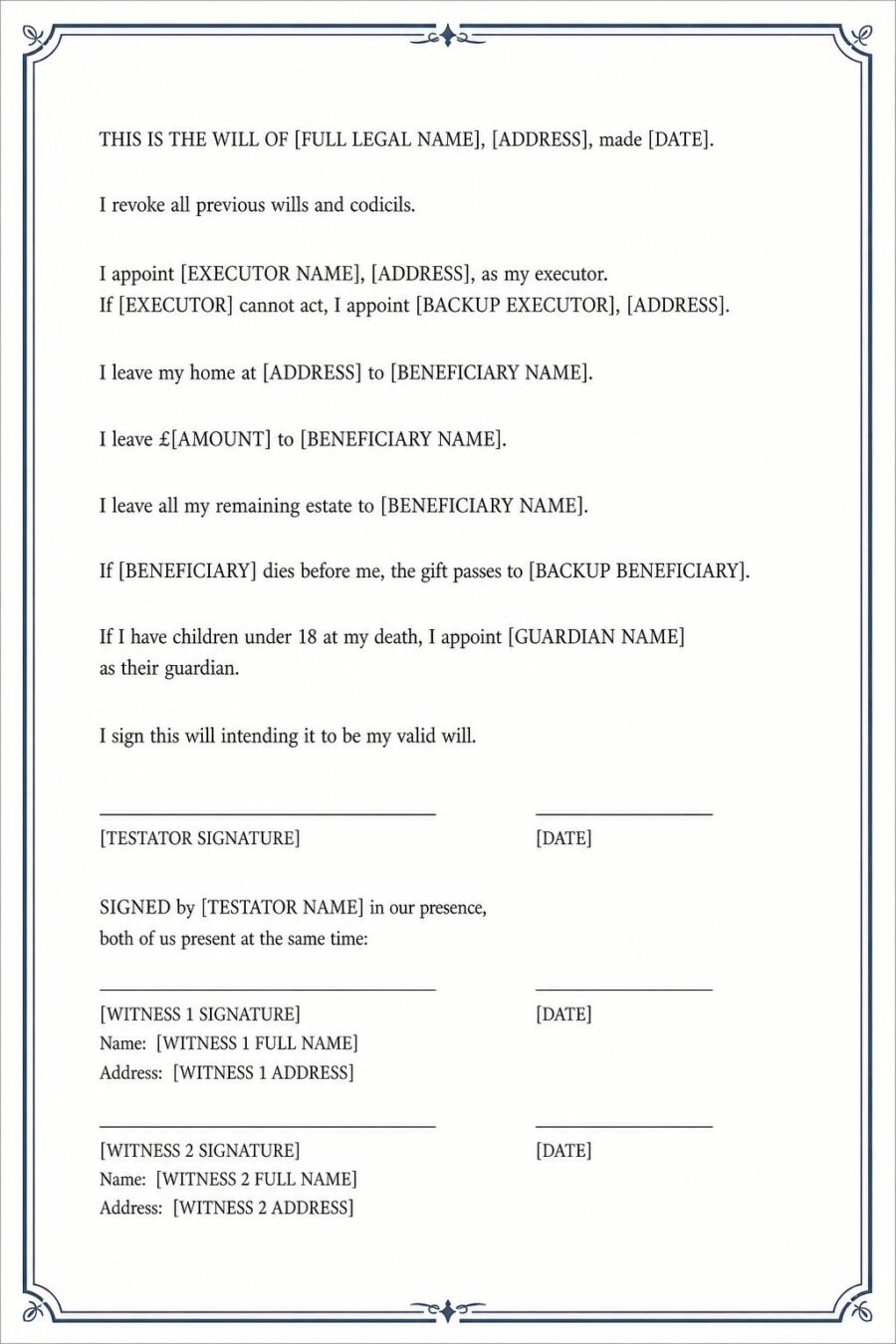
- Opening: “This is the will of [full name] made on [date]”
- Revocation clause: “I revoke all previous wills”
- Executor appointments
- Guardian appointments (if applicable)
- Specific gifts
- Residuary clause (remaining estate)
- Signature section with date
- Witness section with addresses
Keep language clear and specific: “my house” (not “the property I inherited from my mother”).
Step 6: Review before signing
Read the entire document. Check: names are spelled correctly, gifts are clear, executors are named. Print the original document (not a photocopy). Don’t sign yet; prepare for witnessing next.
Free simple will template
A basic simple will template follows this structure:
Mistakes that invalidate a simple will (and how to avoid them)
One error can render your simple will legally ineffective, causing your estate to be distributed by intestacy rules instead:
- Beneficiary witnesses the will: If a beneficiary witnesses your will, they lose their inheritance under Section 15 of the Wills Act 1837. Ask all beneficiaries to leave the room during signing.
- Only one witness: Section 9 of the Wills Act 1837 requires two witnesses. One witness = invalid will.
- Witnesses not present simultaneously: Both witnesses must see you sign at the same time. Signing on different dates invalidates the will.
- Unclear beneficiary names: Saying “£5,000 to my cousin” when you have five cousins creates ambiguity. Use full legal names and addresses.
- Not updating after major life changes: Marriage automatically revokes previous wills (unless made “in contemplation of that marriage”). Divorce doesn’t automatically revoke the will but may affect gift validity. Review every 5 years; remake after marriage, births, or divorce.
- Handwritten changes without re-signing: Striking through words or writing additions creates doubt about intent. Execute a formal codicil or make a new will instead.
- Unclear executor instructions: Saying “my daughter will sort it out” without naming her as executor leaves ambiguity. Courts may appoint an administrator instead.
- Forgetting a residuary clause: If you name specific gifts but don’t state what happens to remaining assets, unused money falls into intestacy. Always include: “I leave all remaining estate to [name].”
- Including illegal conditions: “I leave my house to my daughter, but only if she never remarries.” Courts won’t enforce conditions against public policy.
Do I need a solicitor for a simple will?
A solicitor is not legally required for a straightforward will, but professional guidance provides protection in specific situations.
- Capacity documentation: A solicitor creates written evidence of your mental capacity when signing; critical if family members later challenge your will. Courts rely on contemporaneous professional assessment, reducing challenge risk.
- Execution compliance: Solicitors ensure strict adherence to Section 9 of the Wills Act 1837 witnessing requirements and prevent the most common invalidation errors (beneficiary witnesses, improper presence, signature placement).
- Complexity identification: A solicitor identifies hidden complexity; unmarried partners with inheritance rights, tax thresholds, blended family implications, or conditional gifts requiring trusts.
If your estate is straightforward (single property, standard assets, no family disputes), an online will service provides adequate legal protection at lower cost.
FAQs
Can I leave someone out of my will entirely? Yes. You can disinherit anyone except your spouse or civil partner in some circumstances. However, certain family members (children, dependents) can claim against your estate under the Inheritance (Provision for Family and Dependants) Act 1975 if they believe they haven’t been adequately provided for. Document your reasoning.
What if a witness dies before probate is granted? The will remains valid. Witnesses are only needed at signing; they don’t need to be alive during probate. If the will’s validity is disputed, a deceased witness can’t provide an affidavit confirming proper execution. Choose younger witnesses who are likely to be contactable if needed.
Can I leave my will to a charity? Yes. Name the charity by its registered charity number (not just name) to prevent confusion with similarly named organisations. Leaving 10% or more of your estate to a registered charity may reduce inheritance tax on the remainder, providing tax benefits to your other beneficiaries.
A simple will is the fastest way to protect your family and ensure your wishes are respected. It takes 30 minutes, and costs £50–£150. Meet the five Wills Act 1837 requirements, avoid critical mistakes, and store it safely.
This article provides general legal information for England and Wales only; it does not constitute legal advice. Consult a solicitor for advice on your specific circumstances.
Speak to a wills & probate specialist
If you’re ready to create a legally valid will or need advice on your specific situation, Qredible connects you with experienced private client solicitors and wills & probate specialists in your area.
NEXT STEPS:
- Assess suitability: List your assets and beneficiaries. If your estate is straightforward (single property, standard assets, no blended family), proceed with a simple will. If complexity exists, consult a Qredible solicitor first.
- Choose your method: Decide between DIY template (£10–£50, high risk), online service (£50–£150, recommended), or solicitor (£150–£650+). Complete your will within 30 days while motivation is high.
- Execute and store: Arrange two independent witnesses, sign simultaneously, and store the original safely. Tell your executor the location. Review every 5 years or after major life changes.
Articles Sources
- citizensadvice.org.uk - https://www.citizensadvice.org.uk/family/death-and-wills/wills/
- gov.uk - https://www.gov.uk/make-will/writing-your-will
- boardwalklaw.ca - https://boardwalklaw.ca/top-5-mistakes-people-make-when-writing-a-will/
- lexology.com - https://www.lexology.com/library/detail.aspx?g=23685280-c55a-4879-a39a-d779a5a8505e
Article history
Our team regularly updates Qredible content to ensure clear, up-to-date, and useful information for as many people as possible.
Do you need a solicitor?
Find a solicitor on Qredible in just a few easy steps






Find a solicitor
With over 2,000 solicitors listed, find the one best suited to your needs. We will then help you get in touch.
Contact a solicitorRecent posts